











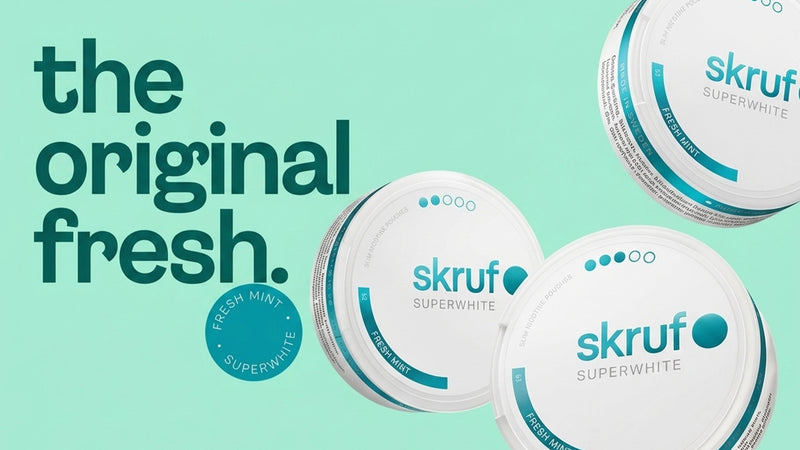


Snus contains ground tobacco, while Nicotine Pouches are completely tobacco-free. However, the application is very similar: both products are placed under the upper lip and in both cases the nicotine is absorbed through the oral mucosa. It is precisely this difference that is legally decisive for Germany: Snus-Tobacco is not allowed to be sold here, tobacco-free Nicotine Pouches however, yes.
With Snus tobacco, a distinct smokeless form of tobacco consumption has emerged that is becoming increasingly popular. At the same time, Snus is one of the most frequently misunderstood tobacco products of all – a situation that has intensified since nicotine pouches have become available on the market as a tobacco-free alternative. To understand the differences between Snus tobacco and other nicotine products, it is worth taking a closer look at the ingredients, production, as well as the legal and health-related aspects of Snus.
What is Snus with tobacco? Definition and origin
Traditional Swedish Snus is a smokeless tobacco made from finely ground tobacco leaves, which are flavored and filled into small portion pouches. It belongs to the group of oral tobaccos, but differs from chewing tobacco both in processing and in use. Instead of being chewed, the moist Snus tobacco is placed under the upper lip. From there, it gradually releases nicotine and flavors, which enter the bloodstream through the oral mucosa – without combustion, smoke, or the spitting that is common with chewing tobacco.1
The name “Snus” gives a clue about the product’s origin: it is derived from the Swedish word for “snuff,” but today refers to a product category of its own. A look at the history of Snus shows just how deeply Snus is rooted in Swedish culture: The roots of modern Snus go back to the 18th and 19th centuries. During this time, farmers began mixing ground tobacco leaves with water and salt into a moist mass that they placed under their upper lip. While chewing tobacco was gradually displaced by snuff and pipe tobacco across large parts of Europe, the development in Sweden took its own path: moist, ground tobacco established itself as a distinct product. With industrialization, Snus ultimately became an everyday product for broad sections of the population.2
 |
Close-up of an original Portion Snus pouch to illustrate the classic product form. |
To this day, the special status of Snus is reflected in legislation: since January 1, 2023, the Food Act (SFS 2006:804) has treated chewing tobacco, Snus, and snus-like products uniformly.3 As a consumer product, Snus is permitted and regulated in Sweden – it may be imported for personal use and purchased online. A health warning must be displayed on the packaging, and the minimum age is 18. However, there are no restrictions on flavor variety or Nicotine content.4
Ingredients of Snus tobacco: What’s in Pouches?
In everyday language, the terms “Snus” and “Nicotine Pouches”, also referred to as “Nicotine Pouches” or “all-white Snus”, are often used synonymously. Although both product groups are available in numerous nicotine strengths and are consumed smoke-free, from a technical and legal perspective they are two different products.
The biggest difference is already clear from the composition. Traditional Snus basically consists of three components: air-cured tobacco, salt, and water. Over time, additional ingredients were added to make the product more durable and refine the flavor, including humectants such as glycerin and propylene glycol, the alkalizing agent sodium bicarbonate, and various flavorings.
Among these additives, sodium bicarbonate in particular plays a crucial role: it raises the pH level and thus affects the concentration of so-called uncharged (free) nicotine – the form that is especially easily absorbed through the oral mucosa. Table salt serves a different purpose: it acts as a preservative and therefore helps extend the product’s shelf life.5
Nicotine pouches, on the other hand, contain no tobacco at all. As the active ingredient, pure nicotine is used, usually in the form of nicotine salts. According to manufacturers, microcrystalline cellulose is also used as a neutral carrier, along with various salts, citric acid, flavorings, and in some cases sweeteners.6
Interested in trying Nicotine Pouches? Here’s a selection of our bestsellers:
Nicotine and nitrosamines
Both Swedish Snus and tobacco-free Nicotine Pouches contain nicotine as the main active ingredient. It is a substance that causes addiction with regular use and can lead to cardiovascular disease.7
In addition to nicotine, Snus contains another group of substances that is important for its health assessment: tobacco-specific nitrosamines (TSNAs). These are carcinogenic, meaning cancer-causing, compounds that form during the cultivation, drying, curing, and processing of tobacco leaves.8 The German Cancer Research Center has identified a total of 28 of these carcinogenic substances in smokeless tobacco products such as Snus.9
How high the TSNA content actually is depends less on the product’s origin than on the specific manufacturing process. This is shown by a laboratory analysis of 64 Snus products conducted by the state health authority in Atlanta. The study found a range of 390 to 4,910 nanograms per gram for the total TSNA level. across all 64 products examined – a difference of more than 12 times between the lowest and highest measured value. In some cases, this can be traced back to the specific manufacturing process: some Snus products undergo tobacco pasteurization instead of fermentation. In this process, bacteria that convert nitrate into nitrite are reduced or eliminated – the key precursor for the formation of tobacco-specific nitrosamines. As a result, the TSNA content in the finished product is lower.10
In concrete terms, this means: products sold under the name “tobacco Snus” can contain very different TSNA levels and therefore cannot simply be treated as equivalent.
The myth about glass splinters
Does Snus contain glass splinters? The short answer is: No. A persistent myth surrounding Snus claims that the tobacco industry adds glass splinters that cause tiny cuts in the gums. Supposedly, this allows nicotine to enter the bloodstream faster and makes addiction set in more quickly. In reality, however, they are salt crystals which – as mentioned above – primarily serve to improve shelf life. To the naked eye, they look like glass splinters, which may have sparked and reinforced this misconception.
How is tobacco Snus made? Pasteurization instead of fermentation
Snus is made through heat treatment and not through fermentation, as is common with many other tobacco products. The manufacturing process is crucial to the product’s health profile.
An overview of the manufacturing process
Broadly speaking, four steps can be distinguished. First, the tobacco leaves are air-dried. This not only increases shelf life, but also brings out the plant’s aromas. As the water content drops, the relative Nicotine content in the dried leaf increases at the same time. The air-dried tobacco is then ground. In the next step, unlike many other smokeless tobacco varieties, there is no fermentation, but rather pasteurization – the tobacco is heated to preserve it. Salt, water, flavorings, and alkalizing agents are then mixed in. These raise the pH level and therefore influence how quickly the body absorbs the nicotine. Finally, the finished product is either packed loose or filled into portion pouches.2
 |
Schematic step-by-step graphic of the Snus manufacturing process: grinding tobacco – heat treatment – mixing ingredients – filling. |
Pasteurization has the biggest impact on the final product. As with food, heat treatment inhibits the growth of bacteria that convert nitrate into nitrite and are therefore involved in the formation of tobacco-specific nitrosamines. Compared with chewing or pipe tobacco, this results in measurably lower concentrations of these carcinogenic compounds. At the same time, the process ensures chemical stability and extends the shelf life of the final product. However, this does not rule out health risks, because both the nicotine it contains and the TSNA levels that remain despite pasteurization make it clear that Snus is not a risk-free product.11
Loose Snus vs. portioned Snus – the two main forms
Snus is available in two basic forms: as loose tobacco and as pre-made portion pouches. Both versions contain the same basic ingredients, but differ in how they are used and, depending on the variant, in their moisture level.
Loose Snus (Swedish: lössnus) is the original form. It is sold in cans as a moist powder. Using a special "portioner" or the index finger and thumb, the user shapes it into a small Portion, which is then placed directly under the upper lip. This method of dosing requires some experience, as the user has to decide how large and therefore how strong each individual Portion will be.
Snuzone Newsletter
Newsletter
Do you like this content? Then sign up for our free NL!
By registering, you accept the privacy policy
Today, portioned Snus is much more common. It is offered in so-called pouches: small, pre-portioned sachets made of fine, porous nonwoven fabric. These are also placed directly under the upper lip and take care of dosing for the user. Two main types can essentially be distinguished:
- Original Portion (also Brown Portion or Brunt Snus): a moist Pouches with a stronger aroma and faster nicotine release, but one that can sometimes leave visible traces on the lip.2
- White Portion (also Vitt Snus): drier on the surface, releases nicotine and flavors more slowly, and therefore feels more discreet.2
In addition, Slim and Mini formats have become established, sitting more discreetly under the upper lip thanks to their slimmer shape. You can learn more about the types and varieties of Snus by clicking the link.
Snus tobacco vs. Nicotine Pouches: what's the difference?
At first glance, Snus tobacco and Nicotine Pouches are very similar, both in terms of format and presentation as well as pH regulation and nicotine absorption through the oral mucosa. The key difference lies in the tobacco itself: Snus contains "real" tobacco as an ingredient, whereas Nicotine Pouches contains only one of its components, namely the nicotine extracted from it. They do not contain tobacco, which makes a major legal difference.
For traditional, tobacco-containing Snus, the legal situation is clear. Under the European Tobacco Products Directive 2014/40/EU (TPD), Title I, Article 2 (8), it is classified as "tobacco for oral use" and is therefore banned from sale throughout the EU – with the exception of Sweden. The directive already came into force in 2014 and was transposed into applicable law in Germany in 2016 through the Tobacco Products Act (TabakerzG) and the Tobacco Products Ordinance (TabakerzV).12
However, the situation is different for novel nicotine products such as tobacco-free nicotine pouches. Since they contain no tobacco, the currently applicable EU Tobacco Directive does not apply here. Instead, they fall under the Novel Food Regulation and are therefore generally considered a novel food. However, approval for placing them on the market is still pending.13
Anyone in Germany looking for a legally available alternative that is similar to Snus in function and use will almost inevitably end up with nicotine pouches. However, it is worth taking a look at the regulatory developments: Nicotine Pouches are also increasingly coming under political pressure. Belgium, for example, already banned tobacco-free Nicotine Pouches in October 2023. In Denmark, on the other hand, Nicotine Pouches fall within the scope of the Tobacco Act and are regulated there as tobacco substitutes.14
Tobacco-containing Snus vs. Nicotine Pouches at a glance
| Snus tobacco | Nicotine Pouches | |
| Contents | Tobacco, water, salt, flavourings | Plant fibres (usually cellulose), nicotine, flavourings |
| Tobacco content | Contains tobacco | Tobacco-free |
| Legal status in Germany | Sale prohibited (§ 11 TabakerzG) – possession & consumption not punishable | Sale legal – so far no specific legal regulation |
| Method of use | Under the lip – absorbed through the oral mucosa | Under the lip – absorbed through the oral mucosa |
Snus tobacco and the legal situation in Germany and the EU
In Germany and virtually throughout the EU, tobacco-containing Snus may not be sold. The basis for this is the already mentioned European Tobacco Products Directive 2014/40/EU (TPD). This directive regulates the manufacture, presentation, and sale of tobacco products and therefore prohibits both the sale and the gifting of Snus in Germany.12
The exception for Sweden has historical reasons. When the country joined the EU in 1995, it received a special provision in the accession treaty due to the long-standing social tradition of snus consumption. This allows the sale and consumption of Snus within Sweden on the condition that the country takes measures to prevent Swedish Snus from reaching other member states.15
What does this mean in concrete terms for consumers in Germany? According to the current legal situation in Germany, possession and consumption of Snus in small quantities for personal use is not punishable. However, this requires that personal use can be plausibly demonstrated. The relevant laws do not explicitly prohibit either consumption or possession, but the person concerned would have to credibly show, based on the Quantity in their possession, that the products are not intended to be placed on the market in the sense defined above.
The key point is this: the ban applies exclusively to tobacco-containing products for oral use. Nicotine Pouches, also known as nicotine pouches or tobacco-free Snus, which, like their tobacco-containing counterpart, originally come from Sweden, do not fall under this directive. In many EU countries, they have become established in recent years as a legal, smoke-free alternative.15
You can also find more detailed information on the legal situation in Germany in our article "Is Snus legal in Germany?".
Health aspects: What does science say about Snus tobacco
Snus tobacco is not a risk-free product – Among the known side effects of Snus include local changes to the oral mucosa (such as leukoplakia), gum irritation and gum recession, and nicotine addiction (which fuels so-called nicotine abuse) – to a similar extent as with cigarettes.16
Nicotine dependence
Nicotine is an addictive neurotoxin. When smoking, it reaches the bloodstream and the brain through the lungs within just a few seconds. Through the oral mucosa, as is the case with Snus, this absorption takes a few minutes. In the body, nicotine makes itself noticeable – regardless of the route of absorption – through a faster heartbeat and higher blood pressure. Anyone who uses smokeless tobacco should therefore be aware that it is just as addictive as smoking itself. If consumption is stopped, nicotine withdrawal symptoms may occur, which can be particularly severe in adolescents.17
Cancer and long-term risks
When it comes to lung cancer, the situation is comparatively clear: since Snus is not burned and no smoke is inhaled, the mechanism by which cigarette smoke damages the lungs is absent. A major systematic review from 2023, which evaluated study data on exclusive Snus users according to internationally recognized standards, found no reliable evidence of risk in this regard. Several studies also show no clear link between Snus use and oral cancer.18
For other types of cancer, the picture is less clear. The same review rates an increased likelihood of esophageal and pancreatic cancer from Snus use as probable. For stomach cancer, the authors also see indications of an increased risk, albeit with less certainty. For several other cancer types examined, such as lymphomas, leukemia, or melanomas, there was only a single study in each case with a limited number of cases, so no reliable conclusion can be drawn from this. There is also a fundamental limitation: since data on women who use Snus is largely lacking, all of the study’s findings – including those on esophageal and pancreatic cancer – apply exclusively to men.18
A possible explanation for the increased risk specifically for the esophagus and pancreas is provided by the nitrosamines in tobacco already mentioned above. Health organizations such as AOK point to their proven carcinogenic potential.19
With tobacco-free nicotine pouches, a substantial part of the cancer risk directly linked to the processing of tobacco leaves is already eliminated – a clear difference compared to tobacco-containing Snus. However, due to the ingredient nicotine, they are not entirely risk-free. That said, there are also variants without nicotine.
Nicotine isn’t for you? Then why not try our nicotine-free Pouches:
Oral mucosa and gums
In addition to these systemic cancer risks, Snus also has a direct effect on mucosal tissue at the point of contact: Since Snus on gums and the oral mucosa sits directly against it, its use can promote gingival recession (receding gums) and oral leukoplakia (whitish changes in the oral mucosa).19
However, the mucosal changes directly at the point where the pouch rests usually recede again: A study by the University of Gothenburg shows that these lesions heal after use is discontinued. In the laboratory, contact with Snus led to a stronger production of pro-inflammatory signaling substances than with tobacco-free nicotine pouches.20
Sources
- "Nicotine pouches and snus" – Factsheet, August 2024(Last accessed on 19.08.2026)
- "Evolution of traditional Swedish snus to nicotine pouches" – WhitePouches.com, Nicopedia(Last accessed on 19.08.2026)
- "The Swedish National Food Agency's regulations on snus, snus-like products and chewing tobacco" – TRIS-Notifizierung 2023/0375/SE, Europäische Kommission(Last accessed on 19.08.2026)
- "Sweden" – Länderprofil, Global State of Tobacco Harm Reduction (GSTHR)(Last accessed on 19.08.2026)
- "Snus" – PharmaWiki(Last accessed on 19.08.2026)
- Deutsches Krebsforschungszentrum (2025). Nikotinbeutel (Nikotinpouches). Fakten zum Rauchen(Last accessed on 19.08.2026)
- Deutsches Zentrum für Herz-Kreislauf-Forschung (DZHK), Newsroom(Last accessed on 19.08.2026)
- National Cancer Institute (NCI), Dictionary of Cancer Terms – "Tobacco-Specific Nitrosamine"(Last accessed on 19.08.2026)
- Deutsches Krebsforschungszentrum - Snus, ein gesundheitsschädliches Tabakprodukt(Last accessed on 19.08.2026)
- Chemical analysis of snus products from the United States and northern Europe(Last accessed on 19.08.2026)
- "What is snus?" – Briefing Paper, Global State of Tobacco Harm Reduction (GSTHR)(Last accessed on 19.08.2026)
- Richtlinie 2014/40/EU des Europäischen Parlament und des Rates vom 3. April 2014(Last accessed on 19.08.2026)
- Merkblatt zu Snus und Nikotin-Pouches der Stadt Ingolstadt(Last accessed on 19.08.2026)
- Snus in Deutschland: Verbot, Strafen und rechtliche Risiken beim Import aus Schweden(Last accessed on 19.08.2026)
- Snus und die Beeinträchtigungen der Mundgesundheit(Last accessed on 19.08.2026)
- Snus: Wirkung und Gesundheitsrisiken der Nikotinbeutel(Last accessed on 19.08.2026)
- A systematic review of cancer risk among users of smokeless tobacco (Swedish snus) exclusively, compared with no use of tobacco(Last accessed on 19.08.2026)
- Tabakprodukt Snus: Was ist das eigentlich?(Last accessed on 19.08.2026)
- Sieber, Jeyakumar, Bornstein, Ramseier: "Snus und die Beeinträchtigungen der Mundgesundheit"(Last accessed on 19.08.2026)
- Alizadehgharib et al. (2022), "The effect of a non-tobacco-based nicotine pouch on mucosal lesions caused by Swedish smokeless tobacco (snus)", European Journal of Oral Sciences, 130:e12885.(Last accessed on 19.08.2026)











Leave a comment